Cart
0
You may also like




ERB Circle members get free delivery from ₹499 and extra 3% off


Save ₹0 on this order. Join ERB Circle, 3 months for ₹299
local_shipping Free delivery above ₹999
We will send you an email to reset your password


Eat Right Basket 0 comments
Real food generally means food that remains close to its original form, with clear ingredients, traceable sourcing and limited unnecessary processing. “Hollow food” is Eat Right Basket’s term for food whose integrity may have been weakened through excessive refining, polishing, added formulations or unclear sourcing. The distinction is not simply organic versus conventional: shoppers should examine ingredients, processing, certification, testing, storage and nutritional composition.
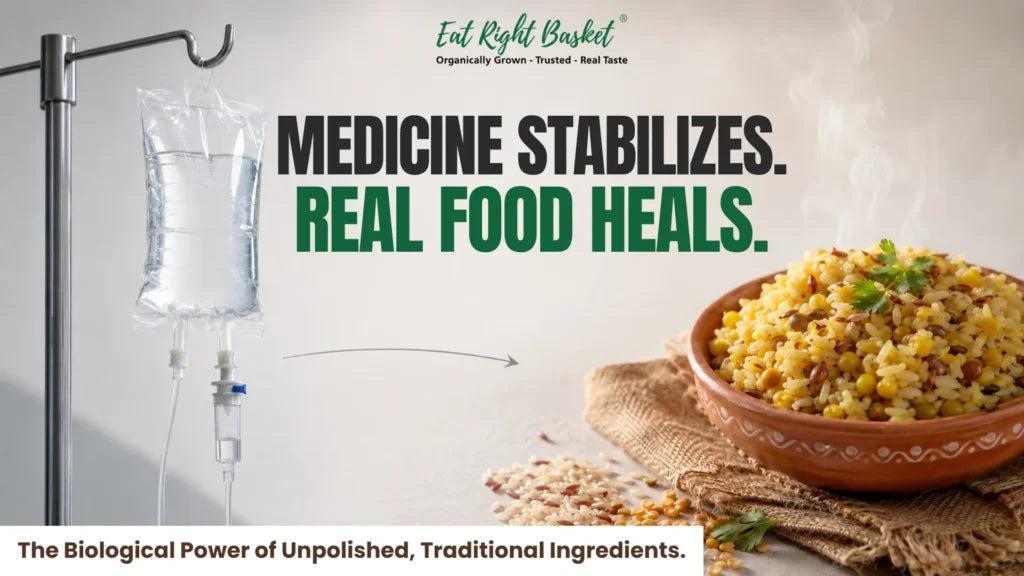
There is a simple, universal protocol in hospitals worldwide. When a patient is too weak to eat or digest, doctors place them on an IV drip. The body receives urgent, carefully monitored nutritional support.
However, no doctor wants to keep a patient on an IV drip forever. As soon as the patient stabilizes, the doctor removes the drip and transitions them back to food. Notice exactly what they prescribe: Daal. Daliya. Khichdi. Soup. Fresh fruits.
They bring the patient back to simple, real food. The human body is not meant to survive on synthetic, emergency support. It is biologically designed to rebuild, heal, and thrive on real ingredients.
This brings us to a critical modern dilemma: If we rely on these staples to heal us, what happens when our everyday food is no longer as "real" as we think?
What if the wheat used for your daily atta undergoes heavy seed treatment, weed-control chemicals, and intensive storage fumigation before it reaches your kitchen? What if your daal is heavily machine-polished, artificially brightened, and stripped of its natural dietary fibre?
At this stage, the threat is no longer just obvious junk food. The silent threat is Hollow Food.
Hollow food fills the stomach but lacks true nutritional integrity. It looks normal, comes in a clean packet, and often boasts marketing buzzwords like "high-protein," "baked," or "multigrain." However, excessive processing, poor sourcing, hidden additives, and chemical residues fundamentally weaken it.
Eating right starts long before the food hits your plate. To understand the severity of the hollow food epidemic, we must look at the verifiable data behind both chemical residue and nutrient loss:
When your daily atta, cooking oil, or evening snacks are compromised, it is not an occasional indulgence, it is a repeated habit. Repeated food habits slowly shape your cellular health over time.
Stop guessing in the grocery aisle. Here is exactly how to tell the difference:
| Feature | Real Food | Hollow Food |
| Ingredient List | Short, recognisable, and easy to pronounce. | Long, containing synthetic syrups, emulsifiers, and stabilisers. |
| Processing Level | Minimal (stone-ground, hand-pounded, single-pressed). | Heavy (refined, bleached, artificially polished, high-heat). |
| Nutritional Integrity | Retains natural dietary fibre, native vitamins, and plant proteins. | Stripped of up to 80% of natural bran and fibre; artificially fortified. |
| Agricultural Inputs | Grown using traditional/organic inputs; no synthetic pesticides. | Grown in depleted soil; heavily exposed to synthetic weedicides. |
| Appearance | Natural variations in size, colour, and texture. | Uniformly bright, perfectly shaped, and artificially glazed. |
Marketers condition consumers to trust the front of the packaging. We see smart colours, fitness buzzwords, and imagery of happy families. But the true story of your food rarely lives on the front.
FSSAI labelling rules require pre-packaged food labels to carry specific, detailed information on the back, including exact ingredients, nutritional breakdowns, and the presence of food additives.
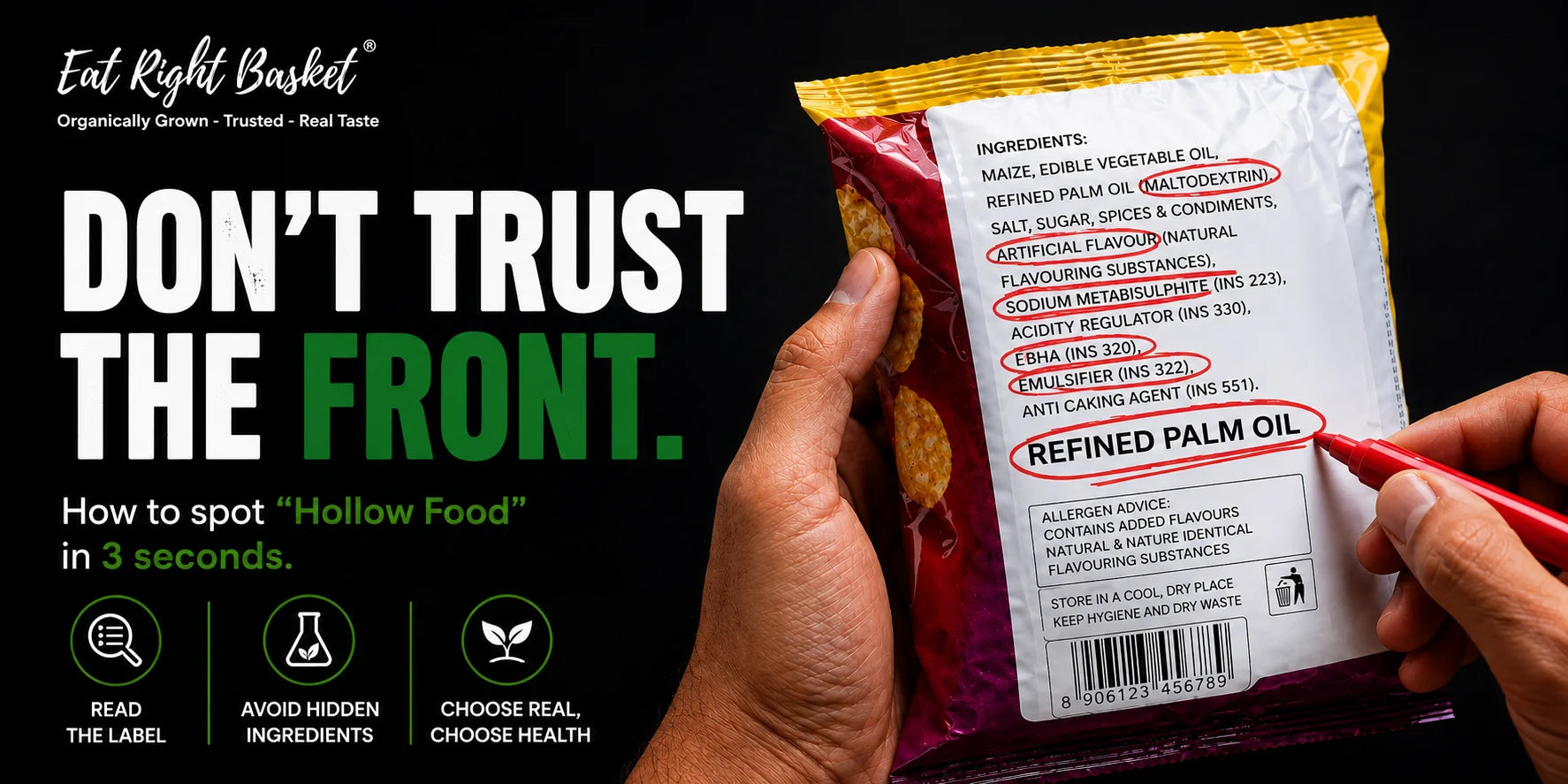
This is why one small habit changes everything: Flip the pack.
Before you trust the marketing, read the first three ingredients on the back. Look out for refined flours, hidden sugars, synthetic syrups, palm oil, and unfamiliar chemical stabilisers. A snack might say "multigrain" on the front, but the ingredient list will tell you exactly what percentage of real grain actually exists inside.
Eating right does not mean turning your kitchen upside down overnight, nor does it mean living in fear of every modern convenience. Eating right means awareness. If you want to eliminate hollow food from your diet today, start by swapping your top three household staples at Eat Right Basket:
Because food is not just about filling your plate, it is about either building your body up or burdening it down, we are officially launching the Eat Right Basket (ERB) Health Series.
Category by category, from atta and cooking oils to daily snacks and sweeteners, we will help you decode your pantry. We will ask the simple, vital questions: What was added? What was polished away? What is real, and what is just marketing?
The next time you pick up a food packet, do not just ask if it is tasty, cheap, or popular. Ask the deeper question: What am I actually eating?
👉 Start Your Pantry Audit: Shop Real Staples at Eat Right Basket
Eat Right. Stay Healthy.
Krishna Awasthi - Brand Manager at Eat Right Basket
Hollow food is heavily processed commercial food that fills the stomach but lacks nutritional integrity due to artificial polishing, chemical farming, and the removal of dietary fibre. While it looks visually perfect, industrial processing strips away native vitamins and replaces them with synthetic additives or preservatives.
You can test for artificial polishing by soaking a handful of daal in cold water for 15 minutes. Unpolished, real daal will leave the water mostly clear, while artificially coloured or heavily polished daal will instantly turn the water cloudy or release a distinct chemical dye into the bowl.
The FSSAI Maximum Residue Limit (MRL) is the maximum legally allowable concentration of synthetic pesticide residue permitted to remain in or on a food product in India. However, repeated daily consumption of foods hitting these maximum limits can still lead to systemic chemical buildup in the human body over time.
Chemical farming reduces native protein levels because synthetic fertilizers deplete the soil's organic carbon and microbiome. According to the Indian Council of Agricultural Research (ICAR), decades of intense urea use have left nearly 40% of Indian soils deficient in micronutrients like zinc, yielding crops that are physically large but biologically empty.
Cold-pressed oil is healthier because it is extracted purely through mechanical crushing at low temperatures, retaining natural antioxidants and safe fatty acids. In contrast, refined cooking oils undergo high-heat processing and chemical solvent extraction (like hexane), which strips the oil of its nutritional value and creates inflammatory trans fats.
No, washing vegetables only removes topical dirt and surface-level sprays. It cannot remove systemic pesticides, chemicals that are absorbed through the root system and integrated directly into the cellular structure of the plant during its growth cycle. Only transitioning to certified organic farming practices eliminates systemic pesticide exposure.
Whole wheat, stone-ground atta retains the bran and the germ, which contain 100% of the grain's natural dietary fibre, iron, and B-vitamins. When wheat is industrially milled into refined white flour (maida), it loses up to 80% of these native nutrients, resulting in a product that causes rapid insulin spikes.