Cart
0
You may also like




ERB Circle members get free delivery from ₹499 and extra 3% off


Save ₹0 on this order. Join ERB Circle, 3 months for ₹299
local_shipping Free delivery above ₹999
We will send you an email to reset your password

Eat Right Basket 0 comments
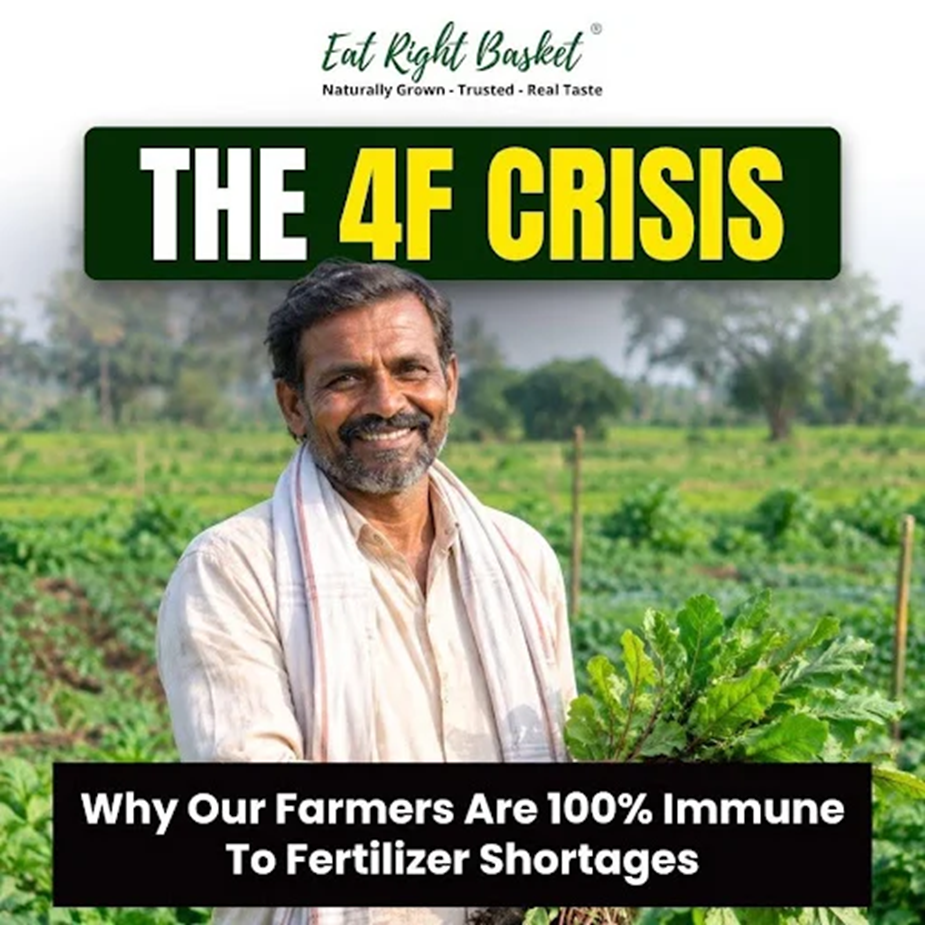
India’s External Affairs Minister recently issued a massive warning to the world about a looming geopolitical threat. He identified it as the "4F Crisis": Food, Fuel, Fertiliser, and Finance.
While this sounds like high-level macroeconomic theory, it exposes a terrifying, immediate reality about the food sitting on your dining table right now.
Modern Indian agriculture is dangerously addicted to foreign chemicals and according to national agricultural data, India currently imports a massive share of its Urea, over 50 percent of its DAP (Di-ammonium Phosphate), and nearly 100 percent of its MOP (Muriate of Potash) because we lack domestic reserves.
This means we have completely outsourced our soil's fertility to foreign supply chains. When a geopolitical conflict erupts thousands of miles away, it disrupts global shipping lanes and skyrockets fuel costs. This literally starves our farms of their chemical inputs, triggering a massive food crisis right here on our land.
If the food you feed your family relies on an uninterrupted supply of imported chemicals, it is neither biologically safe for their bodies nor economically secure for our country.
The world’s biggest economies are finally realizing that this chemical dependency is a dead end. In recent BRICS Declarations, member nations have officially committed to advancing Agroecology and Regenerative Agriculture.
The globe is waking up to a reality that traditional Indian farmers have known for centuries: true food security does not come from a synthetic chemical factory. It comes from living soil. Relying on synthetic, imported fertilizers strips the earth of its natural microbiome and organic carbon, requiring even more chemical intervention the following year just to maintain the exact same yield.
When global supply chains freeze, chemical farms fail.
Here is exactly why organic farming survives global crises while conventional farming collapses:
| Agricultural Metric | Conventional Chemical Farming | ERB Organic Agroecology |
| Fertilizer Source | Imported synthetic Urea, DAP, and Potash. | Local, on-farm compost and cow dung manure (Jivamrit). |
| Pest Control | Imported synthetic pesticides and weedicides. | Indigenous crop rotation and natural biopesticides (Neemstra). |
| Seed Sovereignty | Reliance on patented, hybrid commercial seeds. | Preservation of heirloom, climate-resilient native seeds. |
| Geopolitical Risk | High. Vulnerable to global shipping and fuel crises. | Zero. 100% independent of foreign supply chains. |
| Soil Health Impact | Rapid depletion of soil organic carbon (SOC). | Active restoration of soil microbiome and water retention. |

At Eat Right Basket, we saw the cracks in this fragile, toxic system over a decade ago. We completely walked away from it.
While conventional agriculture panics over global fertiliser shortages and price spikes, our network of certified organic farmers remains completely immune to the 4F crisis. They practice true Seed and Soil Sovereignty.
By utilizing local organic compost, traditional crop rotation, and indigenous seed preservation, our farmers create their own natural inputs right there on the farm. Their soil is living, resilient, and entirely independent of global geopolitical shocks.
Food security is not just a government problem; it is a household decision. Every time you purchase conventionally grown, chemically dependent staples, you are buying into a fragile system that compromises your family's cellular health.
When you buy from Eat Right Basket, you are getting 100% pure, toxin-free food that is resilient, traceable, and grown by independent Indian farmers. You can bulletproof your pantry today by making three simple swaps:
It is time to break the chain of chemical dependency. Protect your family's health, support independent Indian farmers, and bring home food that actually sustains life.
[👉 Secure Your Pantry: Shop the Eat Right Basket Organic Range Today]
Frequently Asked Questions
What is the 4F Crisis in global geopolitics?
The 4F Crisis refers to the interconnected global shortages and price inflations of Food, Fuel, Fertiliser, and Finance. Coined during recent geopolitical conflicts, it highlights how disruptions in global fuel and fertilizer supply chains directly threaten national food security, particularly in nations dependent on agricultural imports.
Why does India import fertilizers like Urea and Potash?
India imports fertilizers because its domestic production capacity cannot meet the massive demand of its chemical-dependent agriculture sector. Furthermore, India lacks natural domestic reserves of Potash, forcing the country to import nearly 100% of its Muriate of Potash (MOP) from foreign nations, making the food supply highly vulnerable to global trade disruptions.
What is Seed and Soil Sovereignty?
Seed and Soil Sovereignty is an agricultural framework where farmers control their own native seed banks and produce their own natural soil inputs (like compost) entirely on the farm. This eliminates their reliance on multinational chemical corporations and insulates local food production from global supply chain failures.
How does agroecology differ from conventional chemical farming?
Agroecology treats the farm as a self-sustaining biological ecosystem, relying on natural crop rotation, organic carbon restoration, and bio-fertilizers. Conventional chemical farming treats the farm as an industrial factory, relying heavily on imported synthetic inputs like urea and DAP to artificially force crop yields while degrading long-term soil health.
Are Eat Right Basket products affected by global fertilizer shortages?
No, Eat Right Basket products are entirely immune to global fertilizer shortages. Our network of certified organic farmers strictly practices agroecology and natural farming, utilizing zero imported synthetic chemicals, ensuring a secure, untainted, and continuous supply of traditional Indian staples regardless of geopolitical conflicts.